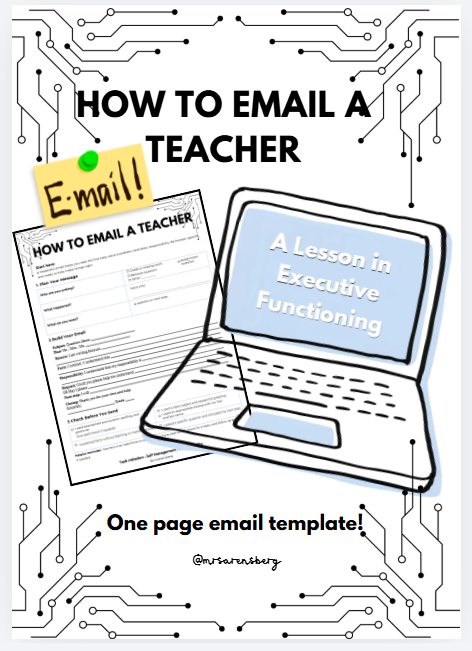
Help students take responsibility for their grades, behavior, and communication with this student friendly email planning template.
Many students know they need to contact a teacher, but struggle with how to begin, what to say, or how to ask for help appropriately. This printable breaks the process into manageable steps so students can initiate the task, organize their thoughts, communicate respectfully, and identify what they can do next.
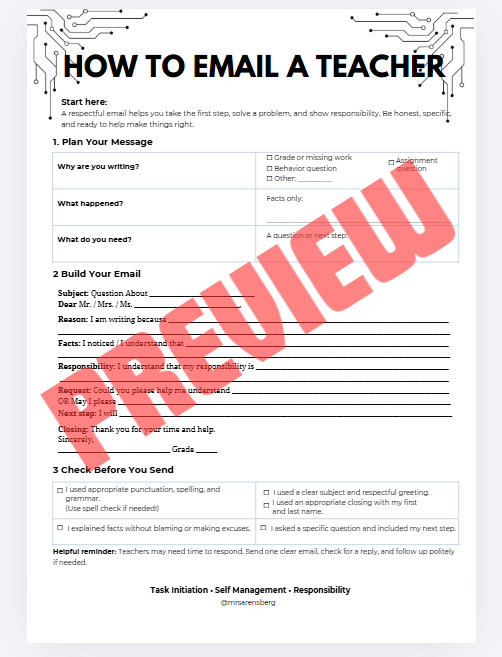
Students will first plan the purpose of their message and identify the facts of the situation. They will then use clear sentence starters to write an appropriate email about a grade, missing assignment, demerit, classroom concern, or other school related issue.
A final checklist encourages students to communicate without blaming, making excuses, or expecting an adult to solve the entire problem for them.
WHAT IS INCLUDED
• One page printable student email planning template
• Message planning prompts
• Professional email format
• Sentence starters for requesting help
• Responsibility and next step prompts
• Before you send student checklist
• Printable PDF format
SKILLS ADDRESSED
• Task initiation
• Executive functioning
• Self management
• Personal responsibility
• Self advocacy
• Written communication
• Problem solving
• Organization
• Social emotional learning
GREAT FOR
• Middle school SEL lessons
• Executive functioning instruction
• Academic support classes
• Advisory periods
• Behavior reflection meetings
• Restorative conversations
• Missing assignment interventions
• Grade conferences
• Demerit or discipline follow up
• School counseling groups
• Individual student support
• Parent and teacher conferences
WHY TEACHERS WILL LOVE IT
This resource gives students enough structure to begin independently while still requiring them to reflect on the situation and take ownership of their choices. It can be used as a direct teaching tool, kept in a student binder, placed in a classroom communication station, or provided whenever a student needs to contact a teacher.
Instead of asking an adult to write the email for them, students are guided through the process of respectfully advocating for themselves.
Help students take responsibility for their grades, behavior, and communication with this student friendly email planning template.
Many students know they need to contact a teacher, but struggle with how to begin, what to say, or how to ask for help appropriately. This printable breaks the process into manageable steps so students can initiate the task, organize their thoughts, communicate respectfully, and identify what they can do next.
Students will first plan the purpose of their message and identify the facts of the situation. They will then use clear sentence starters to write an appropriate email about a grade, missing assignment, demerit, classroom concern, or other school related issue.
A final checklist encourages students to communicate without blaming, making excuses, or expecting an adult to solve the entire problem for them.
WHAT IS INCLUDED
• One page printable student email planning template
• Message planning prompts
• Professional email format
• Sentence starters for requesting help
• Responsibility and next step prompts
• Before you send student checklist
• Printable PDF format
SKILLS ADDRESSED
• Task initiation
• Executive functioning
• Self management
• Personal responsibility
• Self advocacy
• Written communication
• Problem solving
• Organization
• Social emotional learning
GREAT FOR
• Middle school SEL lessons
• Executive functioning instruction
• Academic support classes
• Advisory periods
• Behavior reflection meetings
• Restorative conversations
• Missing assignment interventions
• Grade conferences
• Demerit or discipline follow up
• School counseling groups
• Individual student support
• Parent and teacher conferences
WHY TEACHERS WILL LOVE IT
This resource gives students enough structure to begin independently while still requiring them to reflect on the situation and take ownership of their choices. It can be used as a direct teaching tool, kept in a student binder, placed in a classroom communication station, or provided whenever a student needs to contact a teacher.
Instead of asking an adult to write the email for them, students are guided through the process of respectfully advocating for themselves.